In sport, no one waits until the final siren to work out whether the game plan is working. Coaches and players use half-time to stop, get together, check the scoreboard, and regroup before the second half begins.
January plays that same role for businesses and not-for-profit organisations when it comes to finances.
For most organisations, the financial year runs from 1 July to 30 June. By January, December results are in, the Christmas rush has passed, and you are officially halfway through the financial year. That timing matters. It means you are no longer relying on projections or optimism – you are working with real data.
In simple terms, January is half-time.
It’s also worth acknowledging the reality for many Australian organisations. January can feel disjointed. Schools are still on holidays, routines are out of sync, and “normality” often doesn’t return until late January or early February. If January slips by, February isn’t ideal – but it’s absolutely not too late. Half-time still counts as half-time, even if you’re a few minutes late back onto the field.
The scoreboard doesn’t lie
At half-time in a footy match, the first question is obvious – are we in front or behind?
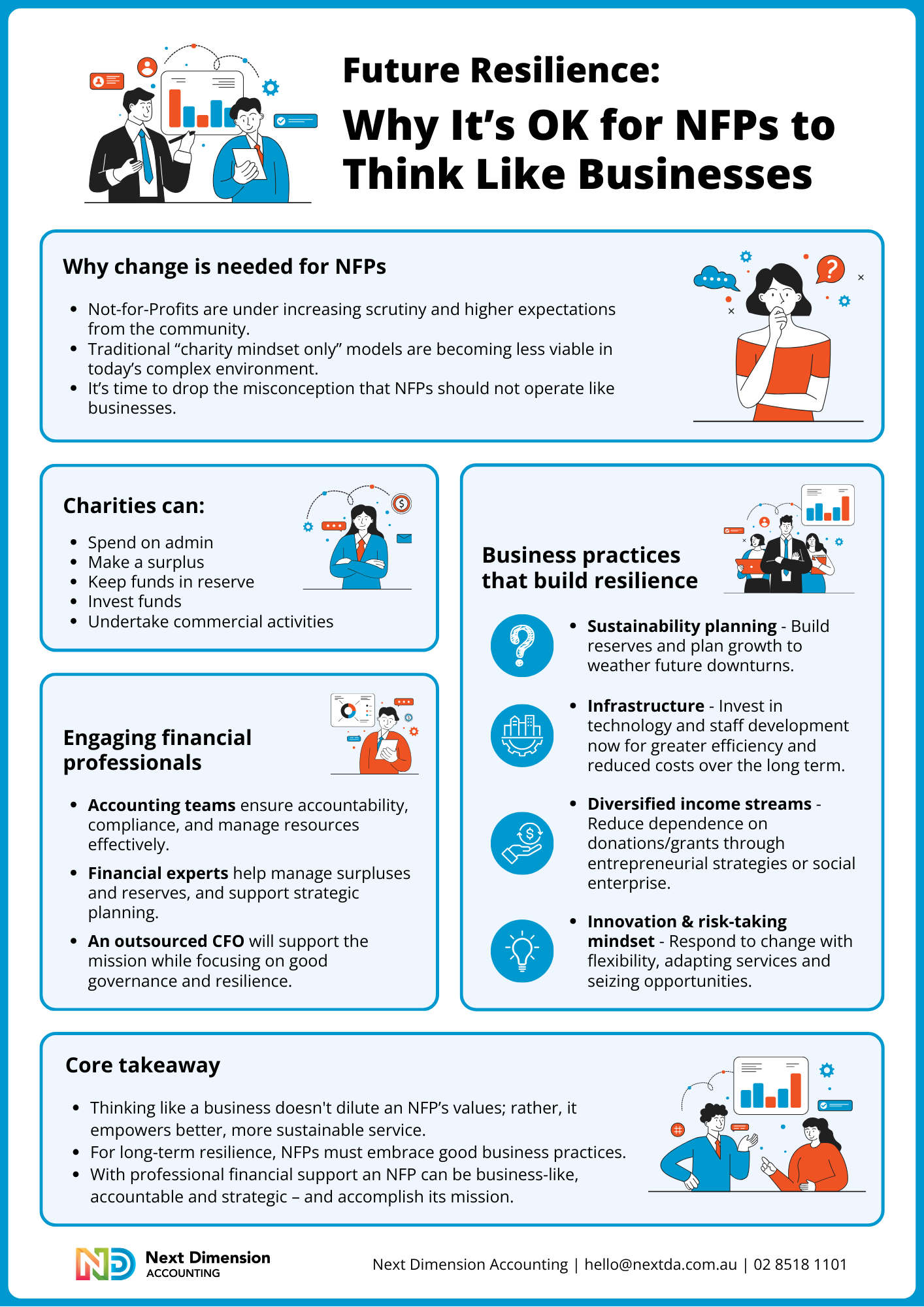
From a financial perspective, January answers that question clearly. Cash flow, profitability, tax position, debt levels, and progress against growth targets are no longer theoretical. You can see what is actually happening, not what you hoped might happen.
If revenue is tracking ahead of plan, that’s good news – but it still raises important questions. Are you genuinely in control, or riding a short-term spike? Is the organisation positioned to push for a strong finish, or is this a season where consolidation and resilience matter more? Should surplus cash be reinvested, used to reduce debt, or held as a buffer?
If performance is behind expectations, January offers something invaluable – time. Being behind at half-time is not a verdict. It’s information. With six months left in the financial year, there is still room to influence the outcome. Whether the goal is a comeback or a sensible rebuild, there are usually options available.
Pricing can be reviewed. Costs can be tightened. Cash flow timing can be improved. Strategy can be refined. Waiting until June to ask these questions is like reviewing game footage after the season has finished – useful for learning, but too late to change the result.
Halfway is where smart adjustments happen
Every sport accepts one basic truth – the original plan rarely survives contact with reality. Conditions change. Injuries happen. The opposition adapts.
Finances work the same way. Costs creep up quietly. Customer behaviour shifts. Interest rates move. Funding conditions tighten or loosen. A half-time review gives you the chance to pause, regroup, and decide what matters most for the second half.
Importantly, this isn’t about tearing everything up and starting again. Good coaches don’t do that at half-time. They focus on small, targeted changes that have the biggest impact.
Financially, that might look like:
- Adjusting pricing or fee structures
- Tightening expense management in specific areas
- Revisiting cash flow timing rather than total revenue
- Refining tax strategies while options are still open
- Re-prioritising projects based on actual performance, not assumptions
Reflection beats regret
There is also a psychological reason January (or early February) is such a powerful moment to review your financial position.
By mid-year, the pressure of year-end deadlines is still some distance away. That space matters. It allows for clearer thinking and better decisions. You are not acting out of panic – you are responding to information.
Author and performance coach James Clear often talks about the importance of reviewing systems, not just outcomes. Half-time is the ideal moment to do exactly that. Instead of asking only “Did we hit the number?”, you can step back and ask more practical, grounded questions:
- Are our systems producing sustainable results?
- Are we relying too heavily on a small number of clients or income streams?
- Are we working harder than we need to for the outcomes we’re getting?
- Have I actually put money aside for tax?
- Is my bank balance truly available cash, or will I need it later?
These are the questions that connect the metaphor to the real, week-to-week decisions being made inside the organisation.
In sport, half-time is often where momentum shifts. Teams that pause, regroup, and refocus tend to come out calmer and more composed. Financially, this moment offers the same opportunity.

The five-step framework: pause, reset, refocus
When half-time works well in sport, it follows a rhythm. The team stops. They look at the facts. They reset the plan. Then they head back out with clarity.
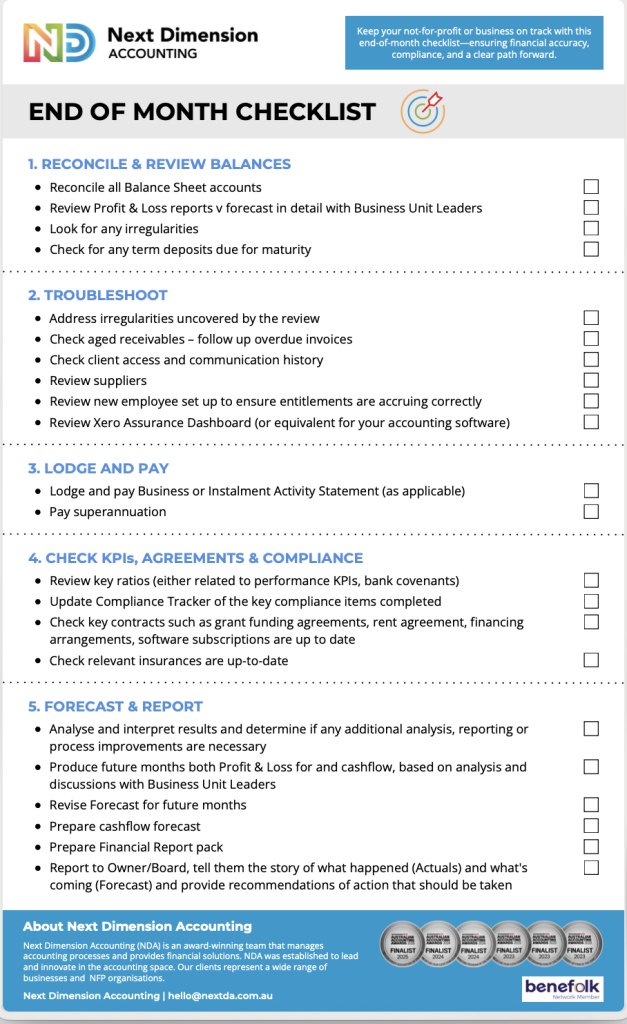
Financial reviews work best the same way. This is the five-step framework we use to turn half-time information into meaningful action:
- Set goals
Be clear about what the second half is for. Is the focus on recovery, stability, or pushing for a strong finish? The answer shapes every decision that follows. - Plan
Adjust the plan based on what the numbers are actually telling you – not what you hoped they would say at the start of the season. - Measure
Look at the right metrics. Cash flow, margins, debt, tax exposure, and capacity matter more than vanity numbers. - Report
Translate the numbers into insight. What’s working? What isn’t? Where are the pressure points? - Action / Reset
Make small, targeted changes, then reset and go again. Half-time isn’t about perfection – it’s about momentum.
This framework reinforces a simple truth: half-time isn’t about judgement. It’s about clarity.
As management thinker Peter Drucker famously said, “What gets measured gets managed.”
Time is still your biggest advantage
From an accounting and advisory perspective, half-time is powerful because time is still on your side.
Tax planning is a clear example. When issues are identified in June, options are limited and reactive. At half-time, there is still room to plan properly – whether that involves restructuring, adjusting superannuation contributions, managing capital expenditure timing, or smoothing income across the year.
The earlier you see the issue, the more tools you have to address it.
Warren Buffett is often quoted saying, “Someone’s sitting in the shade today because someone planted a tree a long time ago.” Half-time is when you can still plant trees that make a difference in the current financial year – not just the next one.
A reset, not a restart
It’s important to be clear about what a half-time review is not.
It is not about judgement. It is not about beating yourself up for decisions already made. And it is not about rewriting history.
In sport, half-time is not a verdict – it’s information.
That mindset matters. Financial reviews work best when they are practical, not emotional. Look at the numbers. Compare them to expectations. Understand why gaps exist. Decide what needs to change. Then reset and go again with clarity and intent.
Leadership expert John Maxwell puts it simply: “Sometimes you win, sometimes you learn.” Half-time is where learning can still turn into winning.
Treat it like half-time, not full-time
The biggest mistake many organisations make is skipping half-time altogether. January drifts by. February fills up. Attention stays elsewhere. The real scrutiny only arrives when deadlines loom, and by then the scoreline is largely locked in.
If you approach this point in the year the way a strong sporting team approaches half-time, it becomes one of the most valuable moments of the season. A chance to stop. A chance to regroup. A chance to decide deliberately how you want the second half to unfold.
The second half hasn’t been played yet.
If you’d like a half-time chat with one of our great Coaches – the kind you’d have in the sheds, not a sales pitch – reach out. Sometimes a short pause and a fresh set of eyes is all it takes to shift momentum.